
What's more, part of that Dumpcollection CKS dumps now are free: https://drive.google.com/open?id=1CAzqxEKoJ0_e4kPHKJQJjBqbfupl2nND
For every candidats, practicing for the pass of the exam is an evitable process, since we can improve our ability. Our CKS Exam Torrent will provide you the practice. The pass rate is 98.88%, and if you fail to pass the test, money back guarantee. Besides, we also have online chat service stuff, if you have any questions, you can have a chat with them, or you can send emails to us, we will give you the reply as quickly as we can.
The CKS certification is designed for security professionals, DevOps engineers, and Kubernetes administrators who want to demonstrate their expertise in securing container-based applications and Kubernetes platforms. Certified Kubernetes Security Specialist (CKS) certification is vendor-neutral and is recognized by a wide range of companies and organizations. The Linux Foundation has been at the forefront of open-source technology, and the CKS certification is a testament to their commitment to providing the highest quality training and certification programs for the technology community.
Linux Foundation Certified Kubernetes Security Specialist (CKS) exam is designed to test a candidate's knowledge and skills in securing container-based applications and Kubernetes platforms. Kubernetes has become the de facto standard for container orchestration and management, and as more organizations adopt this technology, the need for trained professionals who can secure and manage these environments becomes critical. The CKS Certification is an industry-recognized credential that demonstrates a candidate's proficiency in Kubernetes security concepts and practices.
Linux Foundation CKS (Certified Kubernetes Security Specialist) Certification Exam is a professional certification that validates an individual's skills and knowledge in securing containerized applications and Kubernetes platforms. CKS exam is designed for professionals who have experience in Kubernetes and containerization and are looking to advance their careers by demonstrating their expertise in secure container orchestration.
There is no need to worry about virus on buying electronic products. For Dumpcollection have created an absolutely safe environment and our exam question are free of virus attack. We make endless efforts to assess and evaluate our CKS exam question’ reliability for a long time and put forward a guaranteed purchasing scheme. If there is any doubt about it, professional personnel will handle this at first time, and you can also have their remotely online guidance to install and use our CKS Test Torrent.
NEW QUESTION # 61
You are a security engineer tasked with securing your organization's container registry. You need to ensure that only authorized users can push images to the registry, while other users can only pull them. Explain how you would implement this using RBAC in Kubernetes and provide a detailed configuration example.
Answer:
Explanation:
Solution (Step by Step) :
1. Create a Service Account for Registry Operations:
- Create a service account specifically for registry operations: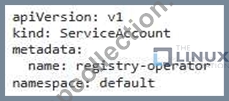
2. Create a Role for Registry Pushers: - Define a role that grants push access to the registry: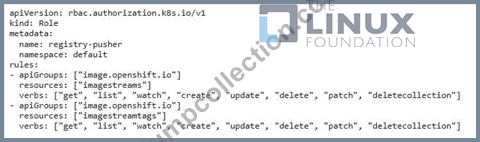
3. Create a RoleBinding to Associate the Role with the Service Account: - Bind the 'registry-pusher role to the 'registry-operator' service account: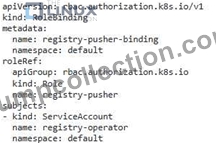
- Apply the role binding definition: bash kubectl apply -f role-binding.yaml 4. Create a Role for Registry Pullers: - Define a role that grants pull access to the registry: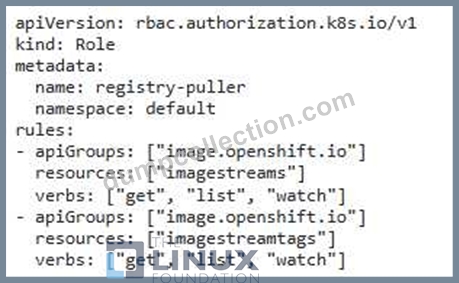
5. Create a RoleBinding to Associate the Role with Users/Service Accounts: - Bind the 'registry-puller role to the desired users or service accounts: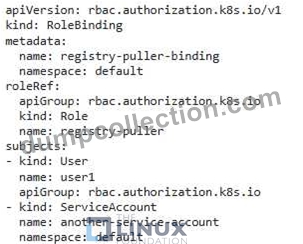
- Apply the role binding definitiom bash kubectl apply -f role-binding.yaml 6. Configure the Registry (Example with Harbor): - In your registry (e.g., Harbor), create project-level permissions and map them to the service accounts you created. This step might involve creating users and groups in Harbor and then associating them with the appropriate projects and roles. By following these steps, you can securely control access to your container registry, allowing only authorized users to push images and restricting others to pulling only.
NEW QUESTION # 62
SIMULATION
Create a new NetworkPolicy named deny-all in the namespace testing which denies all traffic of type ingress and egress traffic
Answer:
Explanation:
You can create a "default" isolation policy for a namespace by creating a NetworkPolicy that selects all pods but does not allow any ingress traffic to those pods.
---
apiVersion: networking.k8s.io/v1
kind: NetworkPolicy
metadata:
name: default-deny-ingress
spec:
podSelector: {}
policyTypes:
- Ingress
You can create a "default" egress isolation policy for a namespace by creating a NetworkPolicy that selects all pods but does not allow any egress traffic from those pods.
---
apiVersion: networking.k8s.io/v1
kind: NetworkPolicy
metadata:
name: allow-all-egress
spec:
podSelector: {}
egress:
- {}
policyTypes:
- Egress
Default deny all ingress and all egress traffic
You can create a "default" policy for a namespace which prevents all ingress AND egress traffic by creating the following NetworkPolicy in that namespace.
---
apiVersion: networking.k8s.io/v1
kind: NetworkPolicy
metadata:
name: default-deny-all
spec:
podSelector: {}
policyTypes:
- Ingress
- Egress
This ensures that even pods that aren't selected by any other NetworkPolicy will not be allowed ingress or egress traffic.
NEW QUESTION # 63
SIMULATION
Create a PSP that will only allow the persistentvolumeclaim as the volume type in the namespace restricted.
Create a new PodSecurityPolicy named prevent-volume-policy which prevents the pods which is having different volumes mount apart from persistentvolumeclaim.
Create a new ServiceAccount named psp-sa in the namespace restricted.
Create a new ClusterRole named psp-role, which uses the newly created Pod Security Policy prevent-volume-policy Create a new ClusterRoleBinding named psp-role-binding, which binds the created ClusterRole psp-role to the created SA psp-sa.
Hint:
Also, Check the Configuration is working or not by trying to Mount a Secret in the pod maifest, it should get failed.
POD Manifest:
apiVersion: v1
kind: Pod
metadata:
name:
spec:
containers:
- name:
image:
volumeMounts:
- name:
mountPath:
volumes:
- name:
secret:
secretName:
Answer:
Explanation:
See the Explanation belowExplanation:
apiVersion: policy/v1beta1
kind: PodSecurityPolicy
metadata:
name: restricted
annotations:
seccomp.security.alpha.kubernetes.io/allowedProfileNames: 'docker/default,runtime/default' apparmor.security.beta.kubernetes.io/allowedProfileNames: 'runtime/default' seccomp.security.alpha.kubernetes.io/defaultProfileName: 'runtime/default' apparmor.security.beta.kubernetes.io/defaultProfileName: 'runtime/default' spec:
privileged: false
# Required to prevent escalations to root.
allowPrivilegeEscalation: false
# This is redundant with non-root + disallow privilege escalation,
# but we can provide it for defense in depth.
requiredDropCapabilities:
- ALL
# Allow core volume types.
volumes:
- 'configMap'
- 'emptyDir'
- 'projected'
- 'secret'
- 'downwardAPI'
# Assume that persistentVolumes set up by the cluster admin are safe to use.
- 'persistentVolumeClaim'
hostNetwork: false
hostIPC: false
hostPID: false
runAsUser:
# Require the container to run without root privileges.
rule: 'MustRunAsNonRoot'
seLinux:
# This policy assumes the nodes are using AppArmor rather than SELinux.
rule: 'RunAsAny'
supplementalGroups:
rule: 'MustRunAs'
ranges:
# Forbid adding the root group.
- min: 1
max: 65535
fsGroup:
rule: 'MustRunAs'
ranges:
# Forbid adding the root group.
- min: 1
max: 65535
readOnlyRootFilesystem: false
NEW QUESTION # 64
You are working on a Kubernetes cluster that iS deployed on a Cloud provider. You need to ensure that the Kubernetes nodes are hardened according to security best practices. Implement a solution that automatically scans the nodes for vulnerabilities and applies necessary security updates.
Answer:
Explanation:
Solution (Step by Step):
1. Choose a vulnerability scanning tool. There are many open-source and commercial tools available, such as Trivy, Anchore, and Clair.
2. Deploy the scanning tool in your cluster- This can be done by deploying the tool as a Daemonset, so that it runs on every node.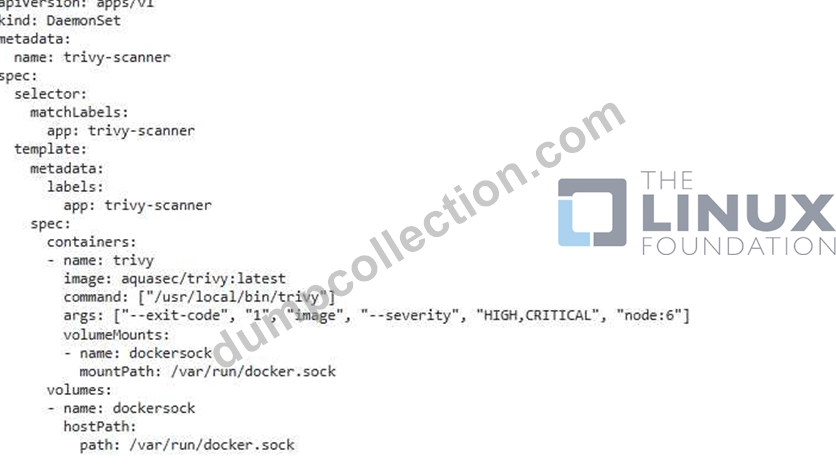
3. Configure the scanning tool to scan the nodes regularly. This can be done using a CronJob or by configuring the tool to run on a schedule.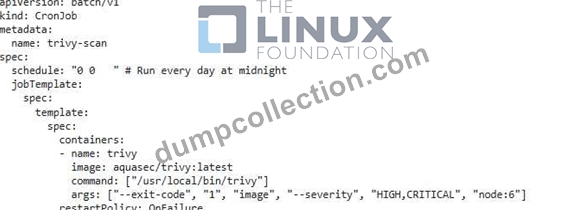
4. Integrate the scanning tool with a security information and event management (SIEM) system. This will allow you to centralize security logs and alerts. 5. Configure automatic updates for your nodes. This can be done using your Cloud providers tools or by using a tool like Kured. Important Considerations: False Positives: Tune the scanning tool to minimize false positives. Remediation: Have a process in place tor remediating vulnerabilities that are discovered. Node Updates: Ensure that node updates do not disrupt your applications.
NEW QUESTION # 65
SIMULATION
Create a network policy named allow-np, that allows pod in the namespace staging to connect to port 80 of other pods in the same namespace.
Ensure that Network Policy:-
1. Does not allow access to pod not listening on port 80.
2. Does not allow access from Pods, not in namespace staging.
Answer:
Explanation:
apiVersion: networking.k8s.io/v1
kind: NetworkPolicy
metadata:
name: network-policy
spec:
podSelector: {} #selects all the pods in the namespace deployed
policyTypes:
- Ingress
ingress:
- ports: #in input traffic allowed only through 80 port only
- protocol: TCP
port: 80
NEW QUESTION # 66
......
In comparison to others, Certified Kubernetes Security Specialist (CKS) (CKS) exam dumps are priced at a reasonable price. It is possible to prepare using CKS exam using a pdf file anytime according to the hectic routines. If you are confused regarding its quality CKS exam dumps, download the free trial to assist you make a final decision prior to purchasing. All exam dumps and patterns are made to follow the style of actual exam dumps. Therefore, it increases your chances of success in the Real CKS Exam.
CKS Upgrade Dumps: https://www.dumpcollection.com/CKS_braindumps.html
P.S. Free 2026 Linux Foundation CKS dumps are available on Google Drive shared by Dumpcollection: https://drive.google.com/open?id=1CAzqxEKoJ0_e4kPHKJQJjBqbfupl2nND