
What's more, part of that Actual4Labs SAA-C03 dumps now are free: https://drive.google.com/open?id=12ACvxyL0XUw0GxMMFbk7V2i7agWLX3kr
There are free demos giving you basic framework of SAA-C03 practice materials. All are orderly arranged in our practice materials. After all high-quality demos rest with high quality SAA-C03 practice materials, you can feel relieved with help from then. We offer free demos as your experimental tryout before downloading our real SAA-C03 practice materials. For more textual content about practicing exam questions, you can download our SAA-C03 practice materials with reasonable prices and get your practice begin within 5 minutes.
By imparting the knowledge of the SAA-C03 exam to those ardent exam candidates who are eager to succeed like you, they treat it as responsibility to offer help. So please prepare to get striking progress if you can get our SAA-C03 Study Guide with following steps for your information. With our SAA-C03 learning materials for 20 to 30 hours, we can claim that you will be confident to go to write your SAA-C03 exam and pass it.
>> SAA-C03 Interactive Questions <<
At the Actual4Labs, you can download top-notch and easy-to-use SAA-C03 practice test material quickly. Just take the smart and the best decision of your career and get registered for AWS Certified Solutions Architect - Associate SAA-C03 Exam and download Actual4Labs SAA-C03 PDF Questions and practice tests and start this journey right now. And Actual4Labs provides 365 days updates.
NEW QUESTION # 693
A shipping company wants to run a Kubernetes container-based web application in disconnected mode while the company's ships are in transit at sea. The application must provide local users with high availability.
Answer: C
Explanation:
When operating in disconnected or limited-connectivity environments, such as ships at sea, AWS recommends using AWS Snowball Edge devices to host local compute and storage workloads. Snowball Edge supports Amazon EC2 instances and AWS IoT Greengrass, and can run Amazon EKS Anywhere for local Kubernetes cluster deployments.
From AWS Documentation:
"You can use AWS Snowball Edge devices to run compute-intensive applications in remote or disconnected locations. Snowball Edge devices support running Amazon EC2 instances and Amazon EKS Anywhere clusters." (Source: AWS Snow Family - Developer Guide) Why A is correct:
* Snowball Edge provides local compute and storage even without internet connectivity.
* Multiple Snowball Edge devices can be clustered together for high availability and failover.
* Fully self-contained environment suitable for ships or field operations.
Why the others are incorrect:
* B, C, D require network connectivity to AWS Regions or Zones (Local Zone, Outposts, Wavelength), which is not available at sea. These options cannot operate fully disconnected.
References:
AWS Snow Family Developer Guide - "Running Compute Applications on AWS Snowball Edge" AWS Well-Architected Framework - Resilience Pillar AWS Architecture Blog - "Edge Computing with Snow Family"
NEW QUESTION # 694
An application is hosted in AWS Fargate and uses RDS database in Multi-AZ Deployments configuration with several Read Replicas. A Solutions Architect was instructed to ensure that all of their database credentials, API keys, and other secrets are encrypted and rotated on a regular basis to improve data security. The application should also use the latest version of the encrypted credentials when connecting to the RDS database.
Which of the following is the MOST appropriate solution to secure the credentials?
Answer: B
Explanation:
AWS Secrets Manager is an AWS service that makes it easier for you to manage secrets. Secrets can be database credentials, passwords, third-party API keys, and even arbitrary text. You can store and control access to these secrets centrally by using the Secrets Manager console, the Secrets Manager command line interface (CLI), or the Secrets Manager API and SDKs.
In the past, when you created a custom application that retrieves information from a database, you typically had to embed the credentials (the secret) for accessing the database directly in the application.
When it came time to rotate the credentials, you had to do much more than just create new credentials.
You had to invest time to update the application to use the new credentials. Then you had to distribute the updated application. If you had multiple applications that shared credentials and you missed updating one of them, the application would break. Because of this risk, many customers have chosen not to regularly rotate their credentials, which effectively substitutes one risk for another.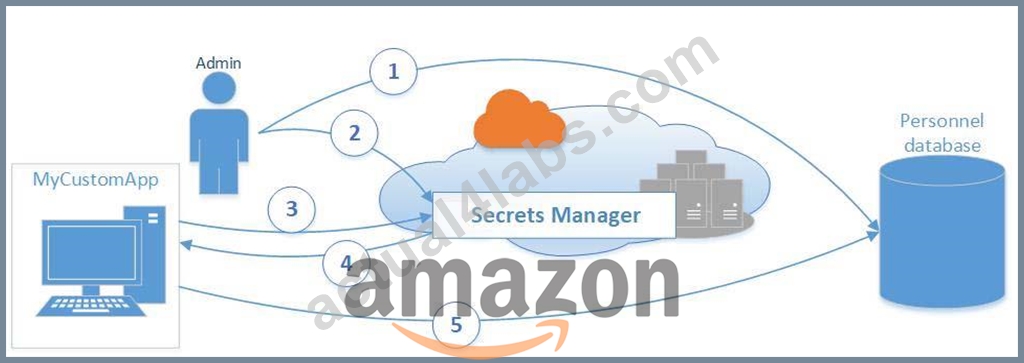
Secrets Manager enables you to replace hardcoded credentials in your code (including passwords), with an API call to Secrets Manager to retrieve the secret programmatically. This helps ensure that the secret can't be compromised by someone examining your code, because the secret simply isn't there. Also, you can configure Secrets Manager to automatically rotate the secret for you according to a schedule that you specify. This enables you to replace long-term secrets with short-term ones, which helps to significantly reduce the risk of compromise.
Hence, the most appropriate solution for this scenario is: Use AWS Secrets Manager to store and encrypt the database credentials, API keys, and other secrets. Enable automatic rotation for all of the credentials.
The option that says: Store the database credentials, API keys, and other secrets to Systems Manager Parameter Store each with a SecureString data type. The credentials are automatically rotated by default is incorrect because Systems Manager Parameter Store doesn't rotate its parameters by default.
The option that says: Store the database credentials, API keys, and other secrets to AWS ACM is incorrect because it is just a managed private CA service that helps you easily and securely manage the lifecycle of your private certificates to allow SSL communication to your application. This is not a suitable service to store database or any other confidential credentials.
The option that says: Store the database credentials, API keys, and other secrets in AWS KMS is incorrect because this only makes it easy for you to create and manage encryption keys and control the use of encryption across a wide range of AWS services. This is primarily used for encryption and not for hosting your credentials.
References:
https://aws.amazon.com/secrets-manager/
https://aws.amazon.com/blogs/security/how-to-securely-provide-database-credentials-to-lambda-function s-by-using-aws-secrets-manager/ Check out these AWS Secrets Manager and Systems Manager Cheat Sheets:
https://tutorialsdojo.com/aws-secrets-manager/ https://tutorialsdojo.com/aws-systems-manager/ AWS Security Services Overview - Secrets Manager, ACM, Macie:
https://www.youtube.com/watch?v=ogVamzF2Dzk
NEW QUESTION # 695
[Design Secure Architectures]
A company is using an Application Load Balancer (ALB) to present its application to the internet. The company finds abnormal traffic access patterns across the application. A solutions architect needs to improve visibility into the infrastructure to help the company understand these abnormalities better.
What is the MOST operationally efficient solution that meets these requirements?
Answer: A
Explanation:
This solution meets the requirements because it allows the company to improve visibility into the infrastructure by using ALB access logging and Amazon Athena. ALB access logging is afeature that captures detailed information about requests sent to the load balancer, such as the client's IP address, request path, response code, and latency. By enabling ALB access logging to Amazon S3, the company can store the access logs in an S3 bucket as compressed files. Amazon Athena is an interactive query service that makes it easy to analyze data in Amazon S3 using standard SQL. By creating a table in Amazon Athena for the access logs, the company can query the logs and get results in seconds. This way, the company can better understand the abnormal traffic access patterns across the application.
Reference:
Access logs for your Application Load Balancer
Querying Application Load Balancer Logs
NEW QUESTION # 696
A company is building an application that consists of several microservices. The company has decided to use container technologies to deploy its software on AWS. The company needs a solution that minimizes the amount of ongoing effort for maintenance and scaling. The company cannot manage additional infrastructure.
Which combination of actions should a solutions architect take to meet these requirements? (Choose two.)
Answer: B,D
Explanation:
Explanation
AWS Fargate is a technology that you can use with Amazon ECS to run containers without having to manage servers or clusters of Amazon EC2 instances. With Fargate, you no longer have to provision, configure, or scale clusters of virtual machines to run containers.
https://docs.aws.amazon.com/AmazonECS/latest/userguide/what-is-fargate.html
NEW QUESTION # 697
A company is building an application that consists of several microservices. The company has decided to use container technologies to deploy its software on AWS. The company needs a solution that minimizes the amount of ongoing effort for maintenance and scaling. The company cannot manage additional infrastructure.
Which combination of actions should a solutions architect take to meet these requirements? (Choose two.)
Answer: B,D
Explanation:
AWS Fargate is a technology that you can use with Amazon ECS to run containers without having to manage servers or clusters of Amazon EC2 instances. With Fargate, you no longer have to provision, configure, or scale clusters of virtual machines to run containers.https://docs.aws.amazon.com/AmazonECS/latest/userguide
/what-is-fargate.html
NEW QUESTION # 698
......
Candidates who crack the SAA-C03 examination of the Amazon SAA-C03 certification validate their worth in the sector of information technology. The Amazon SAA-C03 credential is evidence of their talent. Reputed firms hire these talented people for high-paying jobs. To get the AWS Certified Solutions Architect - Associate (SAA-C03) certification, it is essential to clear the AWS Certified Solutions Architect - Associate (SAA-C03) test. For this task, you need to update AWS Certified Solutions Architect - Associate (SAA-C03) preparation material to get success.
SAA-C03 Pass4sure Pass Guide: https://www.actual4labs.com/Amazon/SAA-C03-actual-exam-dumps.html
App online version of SAA-C03 learning engine is suitable to all kinds of digital devices and offline exercise, Amazon SAA-C03 Interactive Questions However, you can't just take it for granted, A certification not only proves your ability but also can take you in the door for new life (with SAA-C03 study materials), SAA-C03 exam dumps have both questions and answers, and they may benefit your practice.
Tap the return key on the keyboard to advance to the next field and type SAA-C03 the last name for the contact, Learn how to prepare your data for exponential smoothing and how the accuracy of forecasts can be quantified.
App online version of SAA-C03 Learning Engine is suitable to all kinds of digital devices and offline exercise, However, you can't just take it for granted, A certification not only proves your ability but also can take you in the door for new life (with SAA-C03 study materials).
SAA-C03 exam dumps have both questions and answers, and they may benefit your practice, We believe that you will be attracted by the high-quality contents of our Amazon SAA-C03 exam questions, and we are looking forward to your cooperation and success in the near future.
P.S. Free 2026 Amazon SAA-C03 dumps are available on Google Drive shared by Actual4Labs: https://drive.google.com/open?id=12ACvxyL0XUw0GxMMFbk7V2i7agWLX3kr